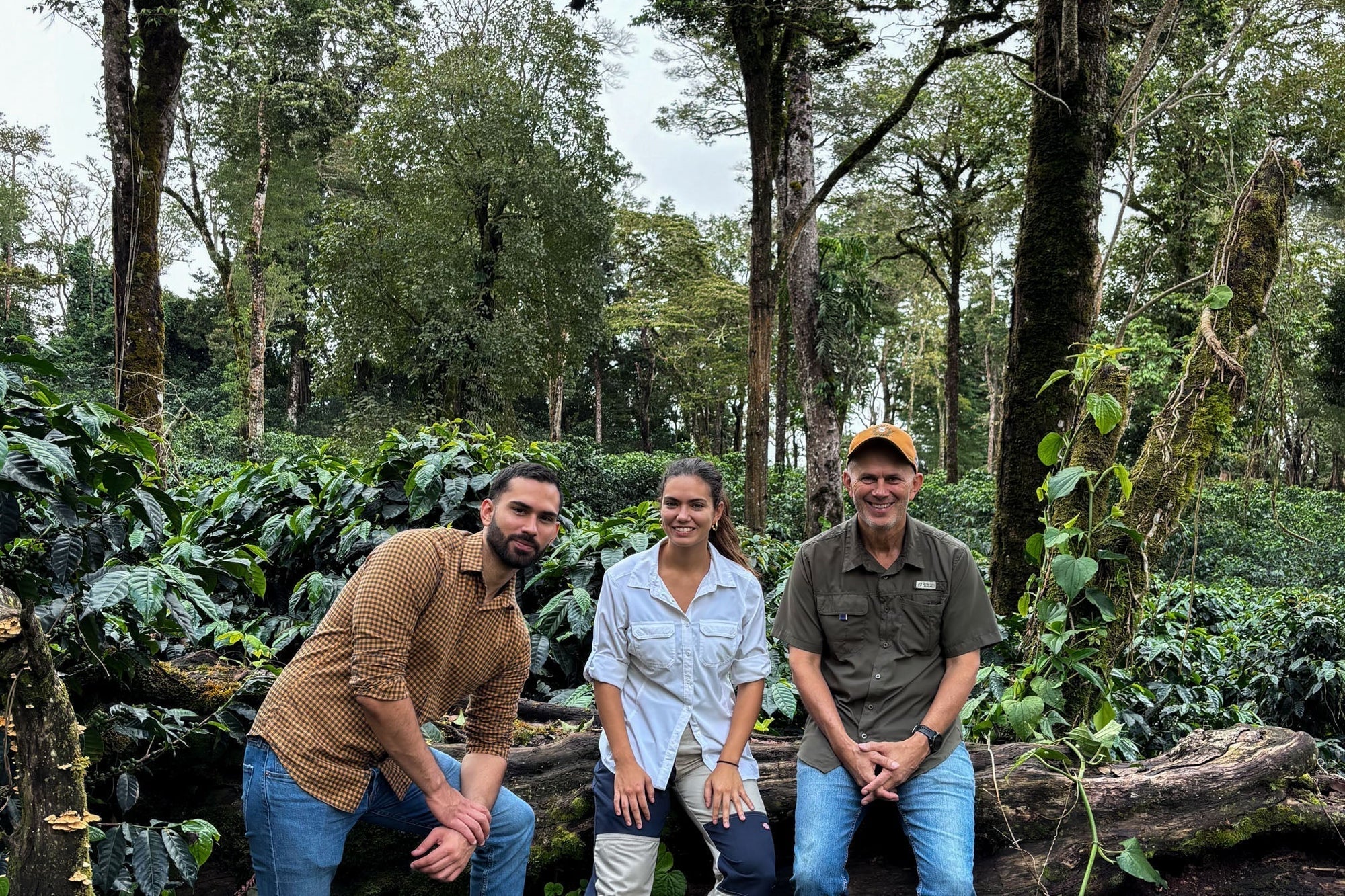
Australian coffee has worn a reputation it did not earn. Low altitude, tiny volumes, basic processing. Danny Andrade has been nudging that story in a different direction since 2014, running post-harvest experiments, sharing results, and showing that careful handling can lift cup scores. In 2019 he met Keith Murray at Glass House Mountain Coffee Project and immediately saw the potential of his farm and the passionate enthusiasm of Keith himself.
Across seasons they made slow and controlled adjustments and incremental improvements with the long term aim to prove that low-elevation coffee can be clean, sweet and worth seeking out. The pair thought it was time to show what they've been working on. The result is two Special Reserve Red Bourbon micro-lots, built together on the farm: Lot 251HS Natural and Lot 252HS Washed plus a bonus small run of cascara from the washed lot as well.
“Our first collaboration was a mix of naturals, washed and honey lots to learn the site. From there we kept what tasted best and made sense for Keith to run.” — Danny Andrade
Keith cares deeply about what Australia grows and how it is perceived. He is honest about the challenges, then gets on with the work. Read on for the story they shared, and what it tastes like in the cup.
The story and the conversation

Danny’s path into processing started in 2011 on farms in Brazil, then turned into a decade of hands-on work. From 2014 he began running small-scale trials here in Australia, proving that micro and nano lots, handled with care, could score higher and taste cleaner than the local market expected. He shared the results openly, which helped shift thinking. At the time, most Australian coffee was processed simply, volume was tiny, labour was expensive, and a low-altitude label did the rest of the damage. Today there are roughly a few dozen farms in the country, only a handful with meaningful scale, so knowledge transfer matters more than machinery.
Keith entered that story in 2019. They met at an event, then walked the Glass House Mountains block together. The brief was practical, not romantic. Keep what works on a small farm, drop what does not, and build repeatability. Season one was a learning sprint, eight to ten test lots across naturals, washed and honey, with different fermentation approaches to map what the site could give. Season two onward they kept the winners and refined them.
“I started off 20 years ago and we did fully washed… I met a young man who showed me some different ways… We’re now using anaerobic fermentation and we’re doing that for two, sometimes three days. And then we add a little bit of water. We don’t wash the coffee at the end. We use the term rinse… and then dried.” — Keith Murray
Keith’s variety mix includes Red Bourbon, Caturra, Pacamara and K7, but Bourbon is the backbone. It suits the farm, gives 90 percent of the usable crop, and carries sweetness and balanced acidity when handled well. The washed lane they now favour is Keith’s “rinsed” approach, depulped the same day, sealed for a short anaerobic ferment of two to three days, then a light rinse and a careful dry. Naturals are kept tidy and thin on beds for even dehydration rather than speed.
When asked "What is something you wish people knew about Australian coffee?" Keith responded with:
“Just how good it is… very few coffee shops are selling single origin Australian coffee. If people were able to taste that they’d be blown away.” — Keith Murray
Keith is a hardcore advocate for Australian coffee and stands behind what he produces. When asked he's not afraid to put his own coffee first as his favourite.
“I like Red Bourbon grown at the Glass House Mountains.” — Keith Murray
“It has its own flavour profile… a nice finish… a little bit acidic… well-rounded… I’ve picked up pineapple in it.” — Keith Murray
Danny’s take after a fresh brew on site matches that brief.
“I have hints of dried fruits, brown sugar, beautiful balanced sweet, malic acidity, and really long sweet finish.” — Danny Andrade
Climate is the hard part. Heat spikes and erratic rain push multiple flowerings, so fruit sets unevenly and labour costs rise. The response has been agronomy choices that make sense at 50 metres above sea level, heavy shade to keep canopy temperatures down, stumping about 20 percent of Bourbon each year to reduce labour and encourage fresh growth, twice-yearly nutrition guided by soil tests, limited grey-water irrigation, and windbreaks across the blocks.
“We only hand pick… we used to go past four or five times now it's eight or nine times each harvest and we only pick the ripe red cherry. Full of sugars, fully developed.” — Keith Murray
Danny’s goal has been to make the work practical for a small Australian farm, not a laboratory exercise but locking in a more control and repeatability in processing meant a deeper understanding of the variables yielding the best results.
The bigger picture is hopeful. More Australian trees are going in, more farms are experimenting, and the knowledge base is catching up.
“I’m quite excited about Australian coffee… we’ve got a number of farmers… planting 100, 150… one fellow has 200,000 trees. That will add significantly to the amount of Australian grown coffee that’s reaching the market.” — Keith Murray
This release sits inside that momentum. Two small lots that show what careful farming and tuned process can do at 50 metres above sea level, built by a grower and a roaster who have been at it together for six seasons and counting.
The harvest day

For this collaboration we decided to invite take a small group of friends and partner cafes to Glass House Mt Coffee Project for a hands-on day that starts on the trees and ends at fermentation. Danny and Keith sets the brief, walks the rows, and shows what ripe looks like on this site. Then everyone got to work. Selective hand picking, careful sorting, float checks, clean water rinses, and the first steps of the sealed ferments for the two Heroes Series lots.
This sits alongside our open-door policy at the roastery, where partners join cuppings and roast days, and have direct contact with the team. The farm day ties it all together. It is a rare chance to connect growing conditions and processing choices to what ends up in the cup.

Explore the release bundle
Lot 251HS · Red Bourbon · Natural · Special Reserve

| Producer / Farm |
Glass House Mountain Coffee Project |
|---|---|
|
Process |
Heroes Series Natural |
| Variety | Red Bourbon |
| Elevation |
~50 MASL |
| Region | Sunshine Coast, Queensland |
| Country | Australia |
Processing
-
Reception and sort
Rinse and clean freshly picked cherries, remove floaters and damaged fruit, drain to dry surface moisture. -
Sealed phase, dry
Days 1–2 in whole cherry inside a sealed container with airlock, no added water. This builds aroma precursors while keeping oxygen low and heat in check. -
Sealed phase, wet
Days 3–7 with water added, container re-sealed with airlock. The liquor buffers acidity and encourages a steadier, cleaner ferment. -
Rinse and reset
Thorough rinse to wash off residual liquor and excess surface acids, leaving intact mucilage for sweetness. -
Bed layout and daily care
Spread in thin, even layers on raised beds. Turn and aerate several times a day. Keep layers pale to prevent hotspots and uneven dehydration. -
Slow dry and finish
Dry for roughly four weeks to 11 percent moisture, protecting from rain and midday heat. Rest in parchment to equalise before milling.
How it tastes
Stewed apricot, orange, rockmelon and honey. Bright medium acidity, smooth medium body, coating mouthfeel and a sweet, fruity finish. Clean and layered rather than boozy.
Why it tastes that way
The first sealed phase in whole cherry builds gentle fruit complexity. Adding water for the second sealed stage moderates the ferment, steering it toward clear stone-fruit and citrus precursors. The rinse strips surface acids and keeps the cup tidy. A long, even bed dry at thin depth locks in aromatics and sweetness, so you taste defined apricot and melon, a bright but balanced line of acidity, and a honeyed finish that lingers.

Lot 252HS · Red Bourbon · Washed · Special Reserve

| Producer / Farm |
Glass House Mountain Coffee Project |
|---|---|
|
Process |
Heroes Series Washed |
| Variety |
Red Bourbon |
| Elevation |
~50 MASL |
| Region |
Sunshine Coast |
| Country |
Australia |
Processing
How it tastes
Clean and composed with bright medium acidity and a balanced medium body. White nectarine and green apple sit over macadamia and raw-sugar sweetness. The mid-palate is tidy, the finish is sweet and medium-long.
Why it tastes that way
Same-day pulping reduces skin influence early, so fruit character stays precise rather than heavy. The two-day sealed ferment with cascara builds gentle aromatics, then the five-day wet sealed phase smooths edges and knits the structure. A careful rinse removes residual liquor and excess acids, and a patient two-week bed dry preserves white-stone-fruit lift and that clean, sweet finish.

Special Reserve · Cascara
What is it?
Cascara is the dried skin and fruit of the coffee cherry. Instead of discarding it after pulping, we clean it, dry it, and treat it like a fine tea. That idea is not random. Danny came up through tea as well as coffee, winning the 2018 Australian Tea Brewers Cup and the 2019 World Tea Brewers Cup, so a fruit-led infusion tied to a farm and a season made perfect sense. When we decided to release Lot 252HS Washed, we set aside its cascara and gave it the same care as the coffee itself.
Why we made it
It showcases the farm in another format with a whole new flavour experience and carries the same traceability as the coffee.
How it tastes
Honey, cedar, orange, macadamia. Gentle sweetness, soft tannin, a clean, nutty finish.

How To Brew
To fully unlock the unique characteristics of these Special Reserve coffees, we recommend trying these brewing methods:

-
Pour Over
- V60
- Origami ceramic dripper
- Hario Switch
- Chemex
- Siphon
- Aeropress
- Delterpress
Each method reveals different layers of flavour, ensuring a memorable cup every time. For more brewing tips, check out our Brewing Guide.
Recipe - Lot 251HS · Red Bourbon · Natural
|
Weight |
Yield |
Temperature |
Extraction Time |
Ratio |
|
20g |
300g |
95℃ |
2:20 Min |
1 : 15 |
Recipe - Lot 252HS · Red Bourbon · Washed
|
Weight |
Yield |
Temperature |
Extraction Time |
Ratio |
|
20g |
320g |
97℃ |
2:40 Min |
1 : 16 |
Recipe - Cascara · Heroes Series · Washed
|
Weight |
Yield |
Temperature |
Extraction Time |
Ratio |
|
10g |
400g |
95℃ |
10:00 Min |
1 : 40 |
About the farm

Glass House Mountain Coffee Project sits on a north-east facing slope, about 50 metres above sea level. Harvest typically runs May to October. Nights sit around 8–10 °C, days in the low twenties. At this elevation they are still mapping how flowering, fruit load and sugar build behave across seasons. Yields swing tree to tree, anywhere from 2 kg to 9 kg, and recent weather has stretched flowering and ripening across a much longer window.
“As a micro-lot producer we will never be a major commercial grower. We are more involved in proving you can grow coffee sustainably at 50 MASL.” — Keith
What they control, and why
-
Shade. Most of the coffee is shade grown. Canopy is critical because leaves start to shut down in the 28–34 °C band. Shade holds leaf temperature down, keeps stomata working and lets cherries mature longer.
-
Pruning and height. Red Bourbon is tall, so they keep labour safe by stumping roughly 20 percent of the block each year to refresh growth and hold picking height in range.
-
Nutrition. Soil tests guide a twice-yearly fertiliser program. The aim is steady nutrient availability rather than big pulses.
-
Irrigation. Limited grey-water irrigation bridges dry spells and keeps trees from stress during heat runs.
-
Windbreaks. Most rows are protected to reduce desiccation and flowering shock.
It's a slow steering in the right direction, learning and improving year by year.
Where this is heading

Australia is not only growing coffee, it is studying it properly. Southern Cross University hosts World Coffee Research’s International Multilocation Variety Trial in Australia, part of a global experiment assessing 31 top-performing varieties across many countries to understand how genetics and environment interact as climates warm. The program was extended in 2025 and runs through 2030, with Australia listed as a partner site.
Why that matters here: the trial is built to capture performance in tougher conditions, including heat and long dry spells, then feed the largest shared dataset of genotype-by-environment results back to growers and breeders. In short, it is designed to inform variety choice and adaptation in places like coastal Queensland.

One site, two processes, and a collaboration built in the paddock, not on paper. Lot 251HS Natural and Lot 252HS Washed show what careful picking and tuned post-harvest can do at 50m in Queensland. Pick up the bundle, taste them side by side, and decide for yourself where Australian coffee is heading.
Get the Australian Special Reserve Bundle
For those interested in establishing a wholesale coffee partnership, head to our wholesale page and fill out the contact form. If you're a venue looking to purchase casually or feature us as a guest roaster, visit Ordermentum to connect and view our price list.